Do you feel empty, unmotivated or stuck in the same patterns? That is not a character flaw. Often the reason lies in old experiences. I help you understand them and live with ease again.
Your nervous system scans for danger because your childhood home was unpredictable. You learned to read moods in order to survive.
Where does this come from?
Just when things get calm, the restlessness comes. This is so common that it has a name: relaxation-induced anxiety.
If your home was unpredictable, through arguments, addiction, illness or moods, your body learned as a child to read the atmosphere constantly. That was wise back then. It protected you.
You are not alone in this. In the large US ACE study with more than 17,000 adults, around two thirds had at least one adverse childhood experience.
Sources: Felitti et al. 1998 (ACE study) · Assor, Roth and Deci 2004 (conditional regard) · Jurkovic 1997 (parentification) · Balban et al. 2023, Stanford (breathing exercise).
An exercise for today
2:1 breathing (Stanford 2023): Breathe in twice briefly through your nose, then out long through your mouth. Calms the traumatised nervous system immediately.
A “no” feels life-threatening because love in your childhood came with conditions (be quiet, function). Guilt is only the echo of old programmes.
Where does this come from?
Studies show: people who grew up like this feel guilt and inner pressure more often and make their self-worth depend more on others.
If affection depended on how good, quiet or helpful you were, a child learns: I am loved when I fit in. Researchers call this conditional regard.
Feeling guilty after a no does not mean you did something wrong. Often it is the old signal that comes with new behaviour. It gets quieter the more often you sit through it.
Sources: Felitti et al. 1998 (ACE study) · Assor, Roth and Deci 2004 (conditional regard) · Jurkovic 1997 (parentification) · Balban et al. 2023, Stanford (breathing exercise).
An exercise for today
Use the gap: Say “I’ll get back to you on that.” Create space between stimulus and response.
Whoever carried the weight of adults early on (comforting parents, caring for siblings) later looks for partners they have to rescue. You become a lighthouse for people who want to drain your light.
Where does this come from?
That is why people you can rescue draw you in, and your own wishes come last.
Many people with this pattern took on adult tasks as children: looking after siblings, comforting parents, quietly solving problems. The technical term is parentification.
Your care for others is a real strength. You do not have to give it up. It is about putting yourself on the list too.
Sources: Felitti et al. 1998 (ACE study) · Assor, Roth and Deci 2004 (conditional regard) · Jurkovic 1997 (parentification) · Balban et al. 2023, Stanford (breathing exercise).
An exercise for today
The inventory: Ask yourself three times a day: “What do I need right now?” Put yourself on the list.
I help you understand old patterns and find your inner light again.
For years I worked in child protection and in youth and family services. I know how childhood experiences still affect us today: in relationships, at work and in how you treat yourself. Together we look at it calmly and without judgement, so you can live with joy and drive again.
State-recognised educational professional · Child protection specialist (§ 8a SGB VIII) · Training in trauma pedagogy German · English · Turkish
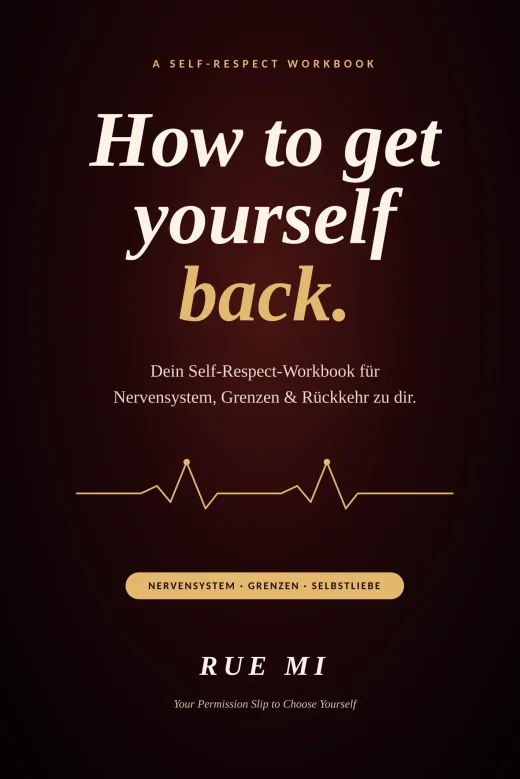
20 chapters on 136 pages: tools for your nervous system, your boundaries and your way back to yourself. By Rue Mi, in German, as a paperback on Amazon.